

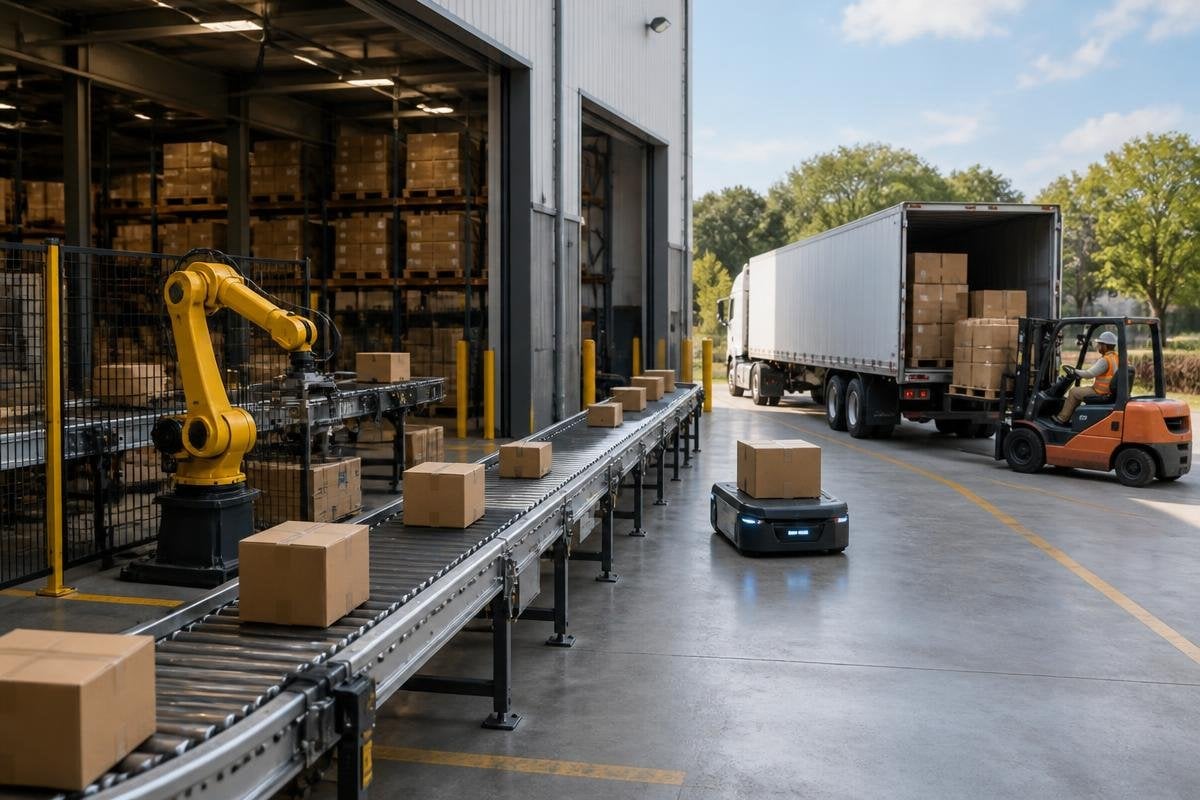
A supply chain can contain software, conveyors, trucks, warehouses, factories, and people. Automating one part helps only when the next part can receive the work, data, and goods without a manual reset.
Quick read
- Robot arms handle repeatable work, while mobile robots move loads across sites.
- Warehouse management systems, manufacturing software, and transport tools must exchange clean data.
- Human checks remain necessary when goods, orders, or conditions fall outside set rules.
The chain is a connected process
Automation starts when one part of the chain hands work to the next. A supplier sends an order record. The factory turns materials into products. Then the warehouse stores and picks them. A carrier moves the shipment to the next address. Every step depends on information from the one before it.
That makes software as important as hardware. A warehouse management system records stock and locations. A manufacturing execution system tracks work on a production line. Enterprise resource planning software connects orders, purchasing, and finance. If these systems disagree, a robot may receive an old location or the wrong quantity.
The fix is not always another robot. It may be a clean data link, a shared item code, or a rule that tells the system what to do when a scan fails.
Where robots fit
Robots work best when the task has a clear input, a known output, and a repeatable path. An automated guided vehicle follows marked routes. An autonomous mobile robot uses sensors and maps to move without fixed floor tracks. A robotic arm uses an end effector, such as a gripper or suction tool, to pick or place an item.
These systems can share work, but each has limits. A mobile robot may carry a tote across a warehouse and stop at a packing station.
The arm still needs to identify the item, reach it, hold it without damage, and place it in the right package. A conveyor may move boxes quickly, yet a person may still need to handle an unusual shape.
This is why claims about a fully automated supply chain need careful checking. A machine can perform one task without handling the exception that surrounds it.
A supply chain can fail at the handoff between robots, software, and people, even when each task works alone. Reporting from Robot24 can help you trace those handoffs across named machines and sites before the next section looks at the exceptions that break them.
The hard part is exception handling
Planned work is easier to automate than damaged packaging, missing stock, blocked routes, or a label that a camera cannot read. A system needs a safe response for each case. That may mean sending the item to a person, asking for a new scan, or stopping a machine.
The handoff between robot and person also needs a clear rule. A worker should know why a task arrived, what has already been checked, and what action will release it. Without that context, automation moves the delay from the machine to the desk beside it.
I’d judge a supply-chain project by its exception rate before its robot count. A fast system that sends many cases to manual review can add work instead of removing it.
What to check before buying
A plan should answer these points before equipment arrives:
- Task boundary: Which exact step will the system perform, and where does human work begin?
- Data path: Which software sends the order, location, and status information?
- Failure route: What happens after a bad scan, blocked path, missing item, or damaged load?
- Physical fit: Can the robot reach the shelf, carry the load, and work safely in the available space?
- Human handoff: Who receives exceptions, and what information appears on their screen?
- Proof point: Which measure will decide whether the project continues, such as completed orders or manual interventions?
The race to automate the whole supply chain will move through these links one at a time. The open question is how many companies will connect those links before adding another machine.